UAV software development using model

Introduction to model-based design

With model-based design, UAV engineers develop and simulate system models comprised of hardware and software using block diagrams and state charts, as shown in Figures 1 and 2. They then automatically generate, deploy, and verify code on their embedded systems. With textual computation languages and block diagram model tools, one can generate code in C, C++, Verilog, and VHDL languages, enabling implementation on MCU, DSP[], FPGA[], and ASIC hardware. This lets system, software, and hardware engineers collaborate using the same tools and environment to develop, implement, and verify systems. Given their auto-nomous nature, UAV systems heavily employ closed-loop controls, making system modeling and closed-loop simulation, as shown in Figures 1 and 2, a natural fit.
Testing actual UAV systems via ground-controlled flight tests is expensive. A better way is to test early in the design process using desktop simulation and lab test benches. With model-based design, verification starts as soon as models are created and simulated for the first time. Tests cases based on high-level requirements formalize simulation testing. A common verification workflow is to reuse the simulation tests throughout model-based design as the model transitions from system model to software model to source code to executable object code using code generators and cross-compilers.

Transitioning to new standards using model-based design

ARP4754A addresses the complete aircraft development cycle from requirements to integration through verification for three levels of abstraction: aircraft, systems, and item. An item is defined as a hardware or software element having bounded and well defined interfaces. According to the standard, aircraft requirements are allocated to system requirements, which are then allocated to item requirements.

The fact that ARP4754A addresses allocation of system requirements to hardware and software components is significant to UAV developers, especially suppliers. Some suppliers might have claimed that UAV subsystem development was beyond the scope of the original ARP4754, even for complex subsystems containing hardware and software, but not anymore. ARP4754A also more clearly refers to DO-178 and DO-254 for item design. In fact, the introductory notes for ARP4754A acknowledge that its working groups coordinated with RTCA special committees to ensure that the terminology and approach being used are consistent with those being developed for the DO-178B update [DO-178C].

Given the high coupling among systems, hardware, and software for UAVs, it is helpful that the governing standards now clarify relationships between systems and hardware/software subsystems.

ARP4754A recommends the use of modeling and simulation for several process-integral activities involving requirements capture and requirements validation.

ARP4754A Table 6 recommends (R) analysis, modeling and simulation (tests) for validating requirements at the highest Development Assurance Levels (A and B). For Level C, modeling is listed as one of several recommendations. While ARP4754 made similar recommendations, ARP4754A provides more insight and states that a representative environment model, such as the plant model shown in Figure 1, is an essential part of a system model.

Also noted in ARP4754A is that a graphical representation or model can be used to capture system requirements. The standard now notes that a model can be reused for software and hardware design.

If engineers use models to capture requirements, ARP4754A recommends engineers consider the following:

1. Identify the use of models/modeling

2. Identify the intended tools and their usage during development

3. Define modeling standards and libraries

refer to:
http://mil-embedded.com/articles/transitioning-do-178c-arp4754a-uav-using-model-based-design/

Posted in Uncategorized | Tagged , , , , | Leave a comment

Almost half of automation sales in Asia

In order to help businesses better understand how to take advantage of the current climate and increase their industrial automation sales in Asia, particularly China, the CC-Link Partner Association (CLPA) is hosting a seminar entitled ‘Gateway to China’. The event will take place on 24th September at the Mitsubishi Electric Europe Tokyo Conference Suite in Hatfield.

In light of the sensitive current economic climate, many Asian companies are taking a more careful approach to investment – they are becoming more demanding towards their suppliers and making more enquiries before purchasing. Furthermore, according to IHS’ research, several Chinese manufacturers are currently developing products which are in direct competition with the ones provided by Western suppliers of industrial automation. These are only a few of the obstacles facing European vendors who want to penetrate the Asian market to change the way they do business.

Flexibility and the ability to respond to very specific demands are becoming essential factors when dealing with the Asian market. Being able to offer technologies and solutions which are compatible with the needs of Asian clients is no longer an option, it’s a must.

– See more at: http://www.connectingindustry.com/automation/asia-claims-almost-half-of-automation-sales.aspx#sthash.4z4uCkA2.dpuf

refer to:http://www.connectingindustry.com/automation/asia-claims-almost-half-of-automation-sales.aspx

Posted in Uncategorized | Tagged , , , , | Leave a comment

Affect your salary – analysis of the salary data

Within the U.S., the highest paid region is the west south central (south), with an average salary of $120,750, which is a $4,180 increase over last year. The lowest paid region is the east north central (midwest), with an average salary of $96,041, a $6,871 increase over last year. (Regions are defined on Wikipedia.)

The average salary of the largest percentage of respondents by job function (28.2%, automation/control engineering) was $105,650, which is a $1,610 increase over last year. The top five highest paid job functions are listed below.

Engineering management: $137,761 (6.6% of respondents), a $5,041 increase
Safety systems engineering: $129,285 (1.1% of respondents), a $7,255 increase
Consulting engineering: $127,398 (3.8% of respondents), a $3,108 increase
Sales (outside): $121,848 (4.5% of respondents), a $4,828 increase
Project management: $120,543 (3.5% of respondents), a $9,323 increase
Of respondents, 69.2% possessed a college degree or higher. The average salary of college graduates (without an advanced degree) is $109,029. The results show that those who attended at least some graduate school (but did not finish) were able to increase their annual salary by $5,647. Those respondents who actually completed an advanced degree reported an average salary of $123,004—that is a $13,975 increase (virtually unchanged from last year) over college graduates.A degree of higher learning

refer to:http://www.automation.com/factors-that-affect-your-salary-what-you-need-to-know

Posted in Uncategorized | Tagged , , , , | Leave a comment

Automation At Remote Sites

For industrial applications, such as oil and gas, power and energy, and water and wastewater renewable, accessing data in real time and keeping network links up and running is critical. More stringent security requirements, such as EPA and NERC, must also be supported as the network continues to evolve. Additionally, an integrated firewall that provides stateful packet inspections, as well as filtering of IPs via access control lists or NAT, is needed to avoid new threats.

More specifically, it is necessary to have integrated user firewall configuration rules that restrict the type and duration of access to authorized individual, user-based permissions and encryption of data to provide adequate security for business-critical applications.

Keeping a closer eye on these infrastructures is necessary not only to prevent loss of revenue, but more importantly, loss of life. Unfortunately, however, networking with remote sites to proactively prevent equipment degradation is far from an easy task and may even require a four-hour helicopter ride. In order to proactively monitor and control remotely located assets, users must be able to access local sensor data. The most cost-effective and intelligent way to do this is through cellular automation.

refer to:http://pipelineandgasjournal.com/using-cellular-automation-monitor-and-control-assets

Posted in Uncategorized | Tagged , , , , | Leave a comment

machine vision has its challenges

Color machine vision has its challenges.
Systems can produce three times the data (or less than one-third the resolution) of a monochrome camera solution. Color can introduce more potential sources for imaging errors, more complexity, more cost, and require careful engineering that reduces the system’s flexibility to deal with lines that make products of varying shape, colors, and size. In fact, if designers can find a way to use filters and lighting to measure a colored area using monochrome cameras, they usually do.
However, for many applications ranging from electronic manufacturing to printing and food processing, color is the only way to solve the problem. Let’s look at some of the considerations a system design needs to take into account to create a successful color machine vision solution, including careful matching of camera, optics, and light source.

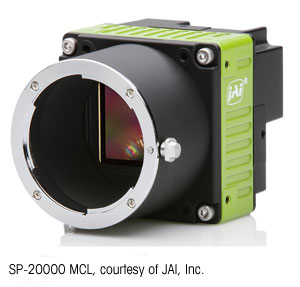
Color aberrations come in two flavors: axial, where the different wavelengths of light cause each color to focus on a different focal plane or distance from the optic, as well as transverse or longitudinal distortion, where a magnification causes different colors to focus on different points on the same focal plane even when they originate from the same point in front of the camera. Both effects can reduce contrast or produce halo effects in the image. While an electronics manufacturer will likely want the fastest possible frame rate and therefore ask for a high-resolution, high-frame-rate single-color camera solution such as JAI’s SP-20000 with 20 megapixel (MP) CMOSIS full-frame sensor (43.3 mm diagonal), the designer needs to be aware of potential lateral distortion and correct the problem through optical or software methods.

refer to:http://www.visiononline.org/vision-resources-details.cfm/vision-resources/Is-Your-Machine-Vision-System-Color-Blind/content_id/4333

Posted in Uncategorized | Tagged , , , , | Leave a comment

BUSINESS TRANSFORMATION THROUGH REMOT

Operational Benefits: Significant advantages included:

A single prioritized view of well operations
Real-time analysis capability for production data
Real-time feedback on well performance
Improved production and forecasting accuracy
Quick implementation as available out-of-the-box
Easily supportable and maintainable monitoring solution
Conformance and integration with corporate standards
But What Really Matters: This solution has facilitated better decision making, helping experts to take the right action at the right time to solve problems, take advantage of opportunities and improve well performance … but so what?

In this particular case, the bigger-picture business goal was time to first oil enabled by an out-of-the-box, customized solution. Even bigger than that, though, is that the refiner estimates a 4-to-6 percent production increase with real-time data networking and analysis.

refer to:
http://www.automation.com/business-transformation-through-remote-collaboration-optimization-and-operations

Posted in Uncategorized | Tagged , , , , | Leave a comment

open hardware from kindergarten to Kickstarter

The “maker” movements of the past few years quickly gained traction in the education and hobbyist markets, as organizations began producing open hardware boards with a “less-is-more” architecture at a price to match. DIY boards like the Arduino, BeagleBoard, and Raspberry Pi provide “known state” programming platforms that allow easy exploring for novice developers, and enough flexibility for advanced hackers to create some pretty remarkable things – which they have solutions.

Now, Kickstarter (www.kickstarter.com) projects like Ninja Blocks are shipping Internet of Things (IoT) devices based on the BeagleBone (see this article’s lead-in photo), and startup GEEKROO is developing a Mini-ITX carrier board that will turn the Raspberry Pi into the equivalent of a PC. Outside of the low barrier to market entry presented by these low-cost development platforms, maker boards are being implemented in commercial products because their wide I/O expansion capabilities make them applicable for virtually any application, from robotics and industrial control to automotive and home automationsystems. As organizations keep enhancing these board architectures, and more hardware vendors enter the DIY market, the viability of maker platforms for professional product development will continue to increase.

refer to:

http://embedded-computing.com/articles/diy-pushes-open-hardware-kindergarten-kickstarter/

Posted in Uncategorized | Tagged , , , , | Leave a comment

Leveraging IT Technology for industrial controls

With that said, the controls world is going to be moving with anautomation that has a definite consumer bias, with product development and release cycles of six months or less. In an industry where the average life expectancy of an automotive production line is eight years, it is impossible to expect the networking in an industrial setting to keep up with modern IT standards. Therefore, we turn our attention to the technologies that have existed the industrial, with the most open standards and the very best support. These are the protocols we wish to use and keep, and this article highlights and explains some of these technologies. This article does not focus on the technical implementations of each piece of technology. Rather, it is assumed the reader will be using packaged solutions such as a function block for a PLC.

refer to:
http://www.automation.com/leveraging-it-technology-for-industrial-controls-applications

Posted in Uncategorized | Tagged , , , , | Leave a comment

RPM or Debian sources recycle apllications

Ever try to rebuild a  embedded computer from RPM or Debian sources? Good luck. While the distribution folks do provide source code (it’s open source, after all), rebuilding from sources is definitely not a use case that they typically support. In most cases, after rebuilding from source packages, the resulting system wouldn’t be considered the same distribution and therefore is unlikely to be supported by the vendor  solutions.

While this might be acceptable for enterprise or  solutions Linux environments, it’s not acceptable for embedded product companies. Typical embedded products are in the field for years, and they often need to be maintained and updated after shipping. It’s critical to keep a detailed manifest of all of the software included in every shipping build of an embedded product, as well as the tools and scripts that were used to build it. A number of modern Linux build engines provide this capability today, so make sure to select one that does.

refer to: http://embedded-computing.com/articles/the-not-code-quality/

Posted in Embedded Computer, Embedded system | Tagged , | Leave a comment

Core graphic skills for vector retrieves

By the graphics core will speed up vector processing applications such as situational awareness, military and medical markets.OEMs also face the challenge of implementing this state-of-the-art technology in their new or existing applications, including validation and verification of the applications’ functionality and access to hardware functions and I/Os. To reduce the amount of R&D work, lower costs and shorten their products’ time to market, they seek ways to cut down their initial development and migration tasks. One approach is to make use of a hardware vendor’ migration services. These embedded products as they are known, are no longer limited to the consumer market. They are making their entrance into the embedded market with the arrival of the new AMD Embedded G-Series platform. OEMs can now add the parallel processing power of the AMD Radeon 6310 GPU to their applications. By doing this, it’s possible to add supercomputer-like performance to small-form-factor embedded designs and obtain a previously unachievable performance-per-watt ratio. Additionally, with the support for OpenCL 1.1 and Microsoft DirectCompute, parallel embedded products .

refer to: http://embedded-computing.com/white-papers/white-small-form-factor-sff-designs-2/


Posted in fanless computer, Industrial computer, IPC Chassis | Tagged , , | Leave a comment